
Book 1, Question 2
Why Does Your Heart Keep Beating While You Sleep?
Your heart keeps beating while you sleep because it makes its own electrical signal, started by pacemaker cells in a spot called the sinoatrial node, so it does not need you to think about it.
Your heart never takes a night off, even when you are fast asleep! It makes its own tiny electrical signal, and a small group of cells called the sinus node acts like the conductor of an orchestra to set each beat. Your brain does not start the beat; it only speeds the heart up or slows it down. The page shares that your heart beats about 100,000 times a day and slows down while you sleep so your body can rest and repair, and it even shows you how to find your own pulse.
Watch the videoWatch on YouTubeBuy on Amazon
Quick answers
Where does each heartbeat start?
In the sinoatrial node, or SA node, in the upper right part of the heart. The signal then travels to the AV node and on to the lower chambers.
What makes the lub-dub sound?
Heart valves snapping shut. Your heart has four valves that keep blood flowing forward.
How can you count your pulse?
Put two fingers on the inside of your wrist below your thumb, count the beats for 30 seconds, and double the number.
Sources: NIH National Heart, Lung, and Blood Institute, KidsHealth (Nemours)
From the book
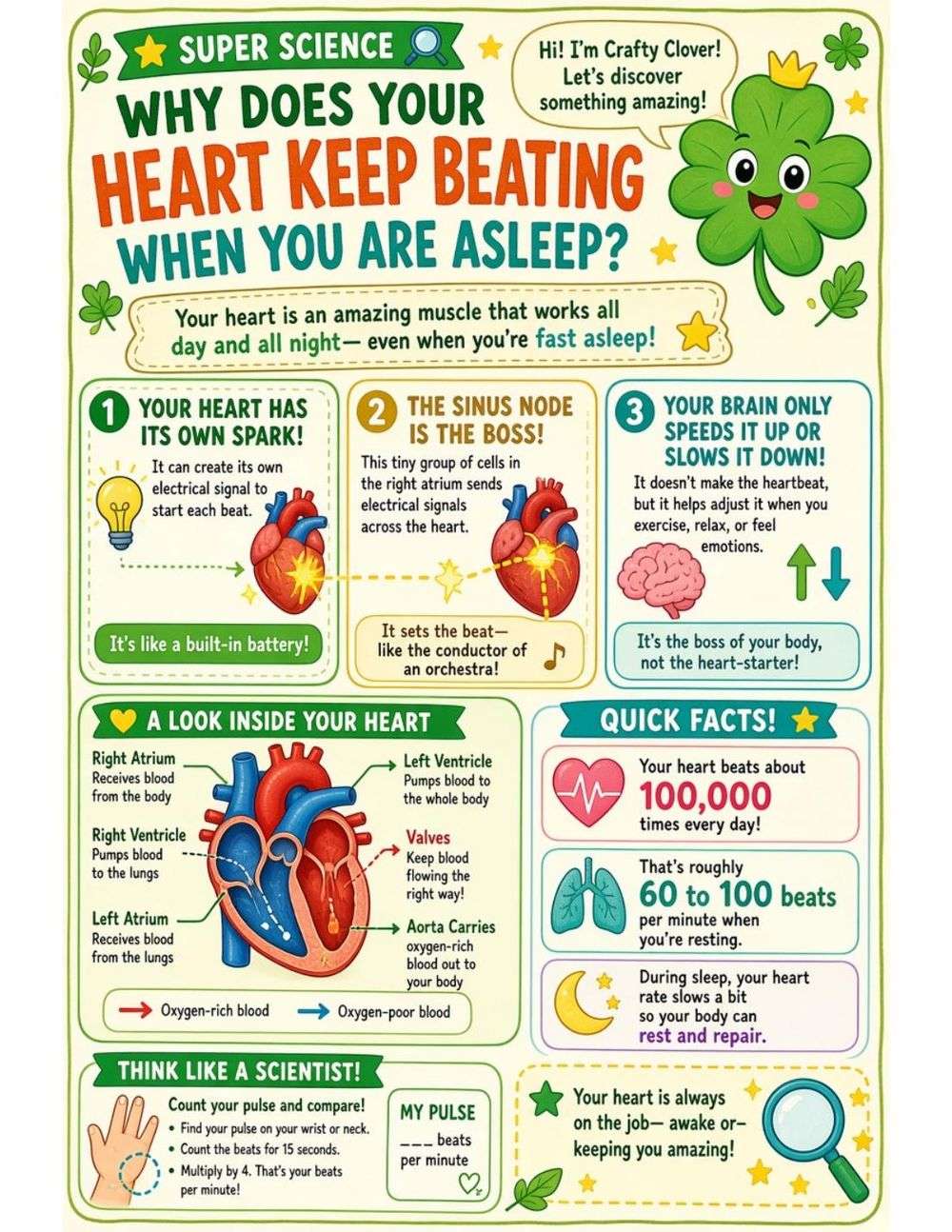
Page from A Million Whys Book 1
More fun facts
- Your heart is about the size of your fist. It sits a little to the left of the middle of your chest.
- Each beat starts in a group of pacemaker cells in a spot called the sinoatrial node, or SA node. It is in the upper right part of your heart.
- The signal then travels to a second group of pacemaker cells called the AV node. That node sends the signal along the walls of the lower chambers so they squeeze and push blood out.
- The lub-dub sound of a heartbeat is made by valves snapping shut. The lub is one pair of valves closing, and the dub is the other pair.
- Your heart has four valves that act like doors. They keep blood flowing forward instead of sloshing backward.
- For grown-ups at rest, a heart rate of 60 to 100 beats per minute is normal. When you exercise, it speeds up to bring more oxygen to your muscles.
- You can count your own pulse. Put two fingers on the inside of your wrist below your thumb, count the beats for 30 seconds, and double the number.
Sources: NIH National Heart, Lung, and Blood Institute, KidsHealth (Nemours)
Questions kids ask
What makes the lub-dub sound?
Valves inside your heart closing. The lub is the mitral and tricuspid valves shutting, and the dub is the aortic and pulmonary valves shutting after blood is squeezed out.
How fast does a heart beat?
For grown-ups resting, 60 to 100 beats per minute is normal. It speeds up when you run or play hard.