
Book 1, Question 54
Why Does It Rain? Follow the Water Cycle!
It rains because the Sun turns surface water into vapor that rises, cools into tiny cloud drops, and falls when the drops grow too big and heavy, as part of the water cycle.
Rain is one stop on the water cycle! The Sun heats water in oceans, lakes and rivers, and it turns into invisible vapor that rises into the air. Up high, the vapor cools into tiny drops that gather to make clouds, and when the drops get big and heavy they fall as rain. The page also covers condensation, precipitation and collection. With a grown-up, heat water in a pot with a lid and watch droplets form underneath.
Watch the videoWatch on YouTubeBuy on Amazon
Quick answers
What is the water cycle?
The nonstop movement of water on, above and below Earth's surface, also called the hydrologic cycle.
Where does it rain the most?
Mawsynram in India averaged about 494 inches of rain a year from 1989 to 2010. Some deserts get less than 0.1 inch a year.
Sources: U.S. Geological Survey, U.S. Geological Survey, NASA
From the book
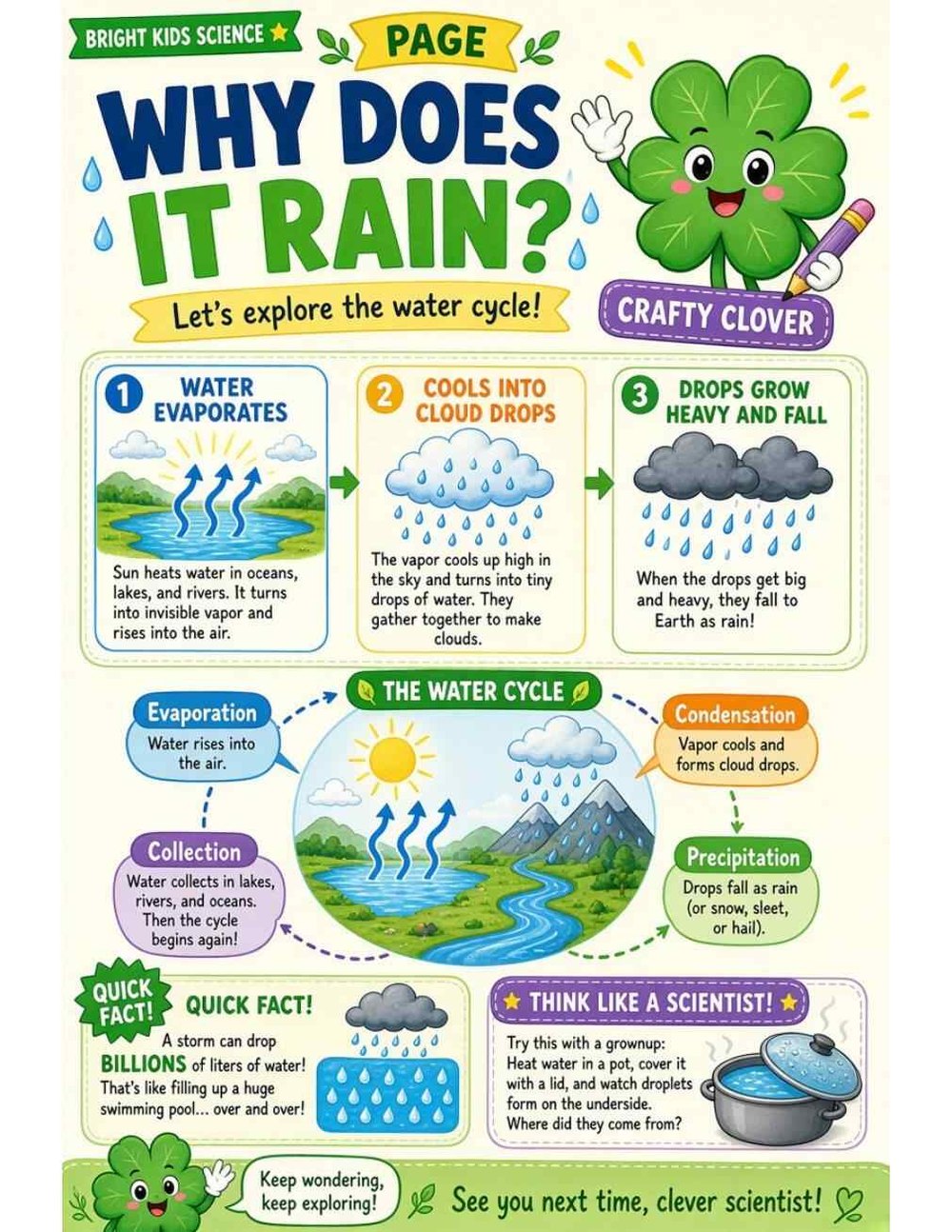
Page from A Million Whys Book 1
More fun facts
- The water cycle is also called the hydrologic cycle. It is the nonstop movement of water on, above, and below Earth's surface.
- Water keeps changing forms between liquid rain, solid ice, and gas vapor.
- Animals, including you, are part of the water cycle. You take in water, use it, and get rid of the extra.
- Some deserts get less than 0.1 inch of rain a year, while some places in the tropics get more than 900 inches.
- Mawsynram, in northeastern India, is one of the wettest places on Earth. It averaged about 494 inches of rain a year from 1989 to 2010.
- Cherrapunji, also in India, got 905 inches of rain in just one year, 1861.
- A rule of thumb says 10 inches of snow equals about 1 inch of water, but it depends on how wet or fluffy the snow is.
Sources: U.S. Geological Survey, U.S. Geological Survey, NASA
Questions kids ask
Where is the rainiest place on Earth?
Mawsynram in northeastern India is one of the wettest, with about 494 inches of rain a year on average.
How much water is in snow?
A rule of thumb is 10 inches of snow makes about 1 inch of water, but it changes with the kind of snow.