
Book 1, Question 66
Why Do the Northern Lights Glow? A Sky Full of Color!
The northern lights glow when energetic particles from the Sun crash into atoms and molecules high in Earth's atmosphere near the poles.
The Northern Lights are a glowing show high in the sky. The Sun sends out streams of charged particles, and Earth's magnetic field acts like an invisible shield that guides them toward the North and South Poles. When the particles hit gases in the air, the gases glow: oxygen makes green and red, and nitrogen makes purple and blue. The page says the aurora usually happens about 80 to 300 km above Earth, and you can look at an aurora forecast map to see where it might glow tonight.
Watch the videoWatch on YouTubeBuy on Amazon
Quick answers
What are the names of the lights?
Near the North Pole they are the aurora borealis, which means northern dawn. Near the South Pole they are the aurora australis.
Do other planets have auroras?
Yes. They have been seen on Jupiter and Saturn.
Sources: NASA Space Place, NASA Science
From the book
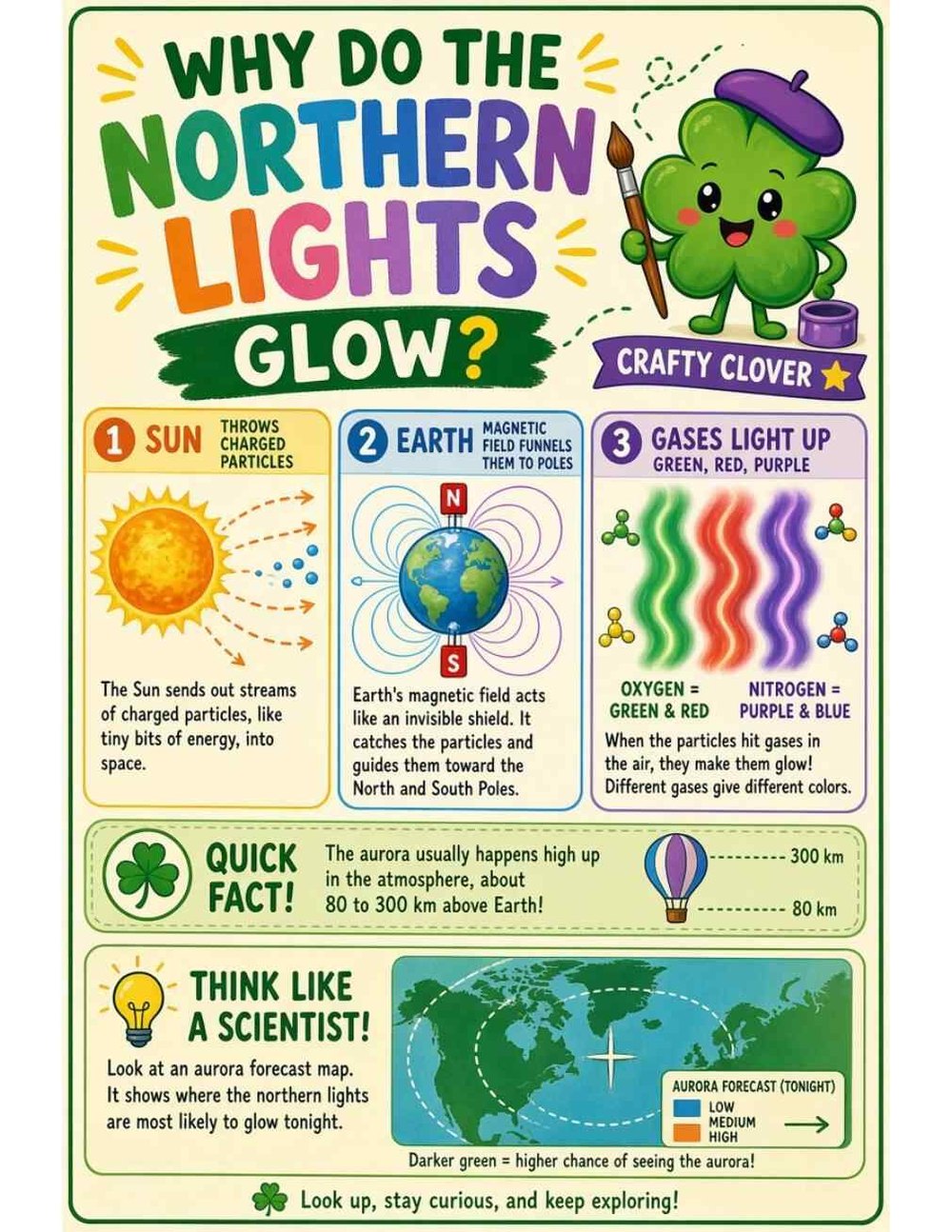
Page from A Million Whys Book 1
More fun facts
- Near the North Pole, the lights are called the aurora borealis. Near the South Pole, they are the aurora australis, or southern lights.
- Aurora is the Latin word for dawn. Aurora borealis means northern dawn.
- Earth's magnetic field shields us from most of the Sun's energy and particles, so we do not even notice them.
- During a solar storm called a coronal mass ejection, the Sun burps out a huge bubble of electrified gas that zooms through space.
- Auroras glow when energetic particles crash into atoms and molecules high in the atmosphere.
- Auroras happen on other worlds too. They have been seen on Jupiter and Saturn.
- Astronauts on the International Space Station have photographed auroras from above.
- People around the world have watched and recorded auroras for thousands of years.
Sources: NASA Space Place, NASA Science
Questions kids ask
Are there southern lights too?
Yes. Near the South Pole they are called the aurora australis, or southern lights.
Do other planets have auroras?
Yes. Auroras have been seen on Jupiter and Saturn.