
Book 1, Question 119
How Does Wi-Fi Work? Invisible Radio Waves!
Wi-Fi works by sending information on invisible radio waves between a router and your device.
Wi-Fi feels like magic, but it is radio. A box called a router sends invisible radio waves, and your device catches them. The waves carry tiny on-off codes that become pictures and words. The page says Wi-Fi is radio, not a little internet string. Walk farther from the box and notice whether a page loads slower.
Watch the videoWatch on YouTubeBuy on Amazon
Quick answers
Why can't we see Wi-Fi?
Radio waves are in the same family as light, but our eyes can only see a small part of that family.
Who proved radio waves exist?
Heinrich Hertz, in the late 1880s.
Sources: NASA Science, NASA Science, NASA
From the book
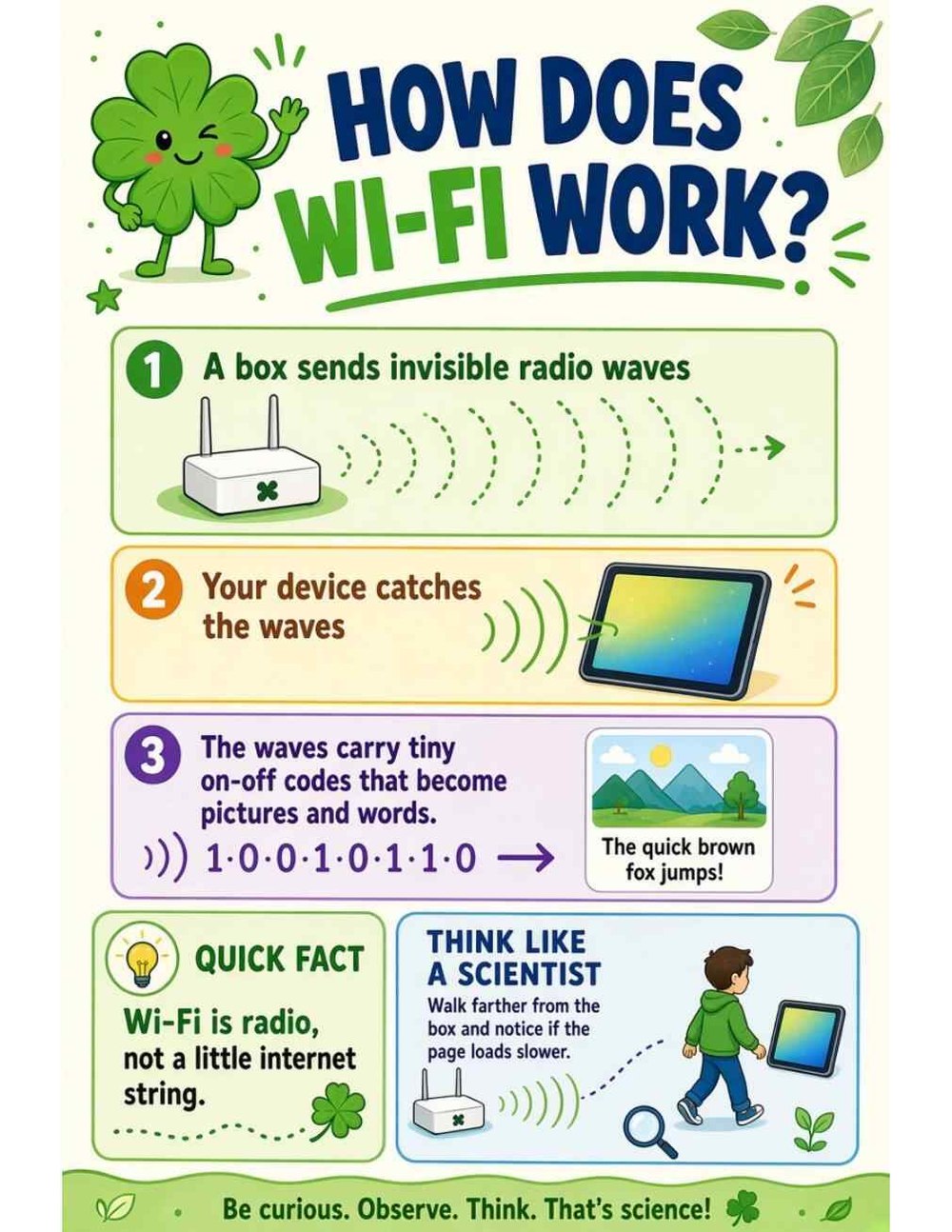
Page from A Million Whys Book 1
More fun facts
- Radio waves are part of the electromagnetic spectrum, the same family as visible light.
- Our eyes can only see a small part of that spectrum, which is why we can't see Wi-Fi signals.
- Radio waves have the longest wavelengths in the electromagnetic spectrum.
- Heinrich Hertz proved that radio waves exist in the late 1880s.
- In 1932, Karl Jansky discovered that stars and other objects in space give off radio waves.
- To send information, a transmitter changes the shape of the wave in tiny ways to stand for the data.
- NASA uses radio waves to talk with astronauts and rovers, and is testing lasers to send even more data.
Sources: NASA Science, NASA Science, NASA
Questions kids ask
Why can't we see Wi-Fi?
Wi-Fi uses radio waves, and our eyes only see a small part of the spectrum called visible light.
Who discovered radio waves?
Heinrich Hertz proved they exist in the late 1880s.