
Book 2, Question 53
Why Do We See in Color?
We see in color because cone cells at the back of the eye sense different kinds of light and the brain turns those signals into color.
Color is how your brain reads the different kinds of light. Special cells in the back of your eye catch the light and read it as color. Then your brain puts all the signals together, and you see the world in color.
Watch the videoWatch on YouTubeBuy on Amazon
Quick answers
What do rods do?
Rods only sense light, while cones sense color.
How much light can people see?
Only a tiny sliver of all the light that exists, about 0.0035 percent.
Sources: Cleveland Clinic, Science News Explores, Cleveland Clinic
From the book
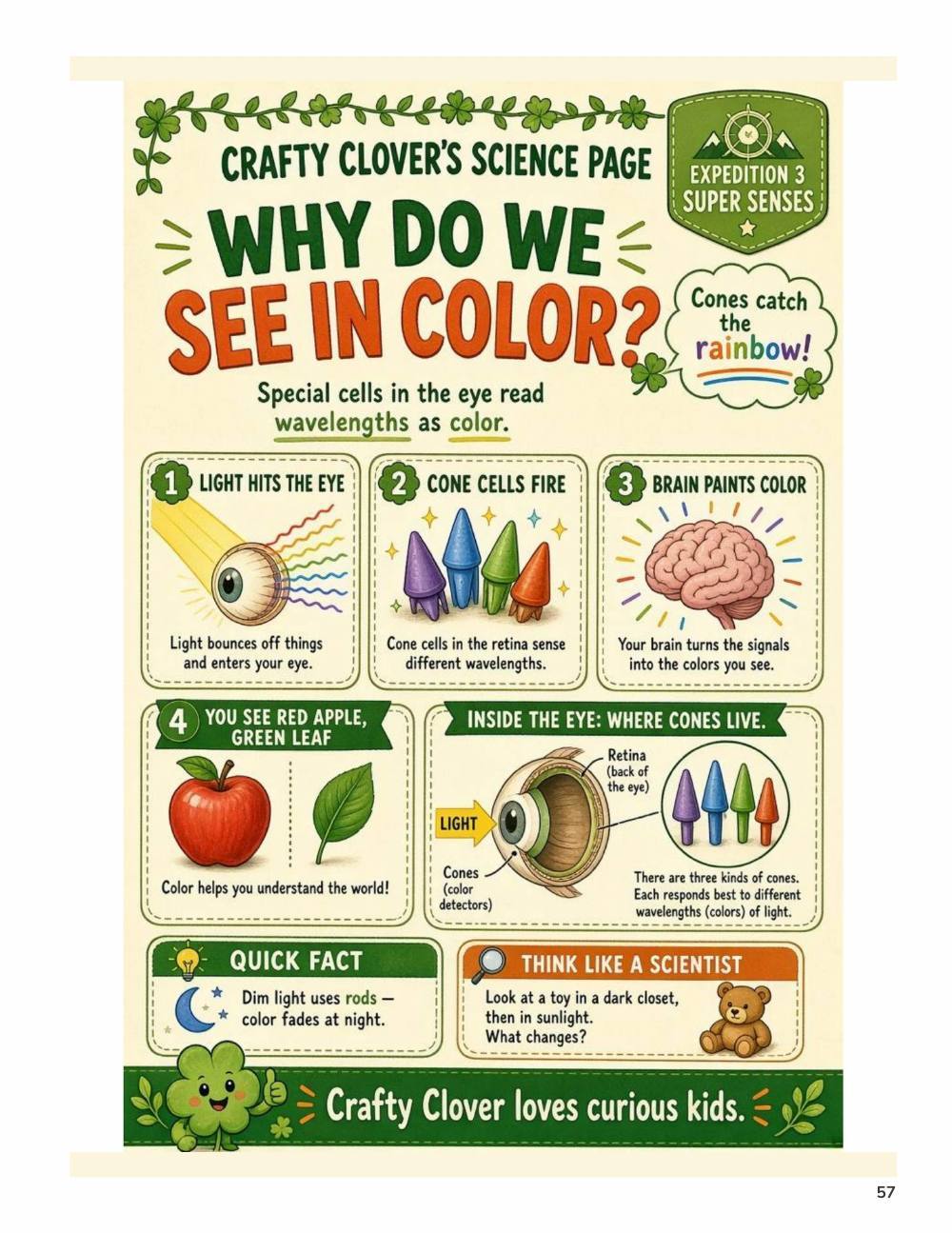
Page from A Million Whys Book 2
More fun facts
- The back of each eye is lined with millions of light-sensing cells called photoreceptors.
- Some photoreceptors are shaped like rods and some like cones.
- Rods only sense light, while cones sense color.
- People can see only a tiny sliver of all the light that exists, about 0.0035 percent.
- The name ROYGBIV helps you remember the rainbow's order: red, orange, yellow, green, blue, indigo, and violet.
- Purple is special. Scientists say our brain makes it up by mixing signals.
- Color blindness happens when some of the color-sensing cells are missing or do not work properly. Most people with it are born that way.
Sources: Cleveland Clinic, Science News Explores, Cleveland Clinic
Questions kids ask
Why can some people not see certain colors?
Some of the color-sensing cells in their eyes are missing or do not work properly. Most are born that way.