
Book 3, Question 30
Why Do Solar Panels Work?
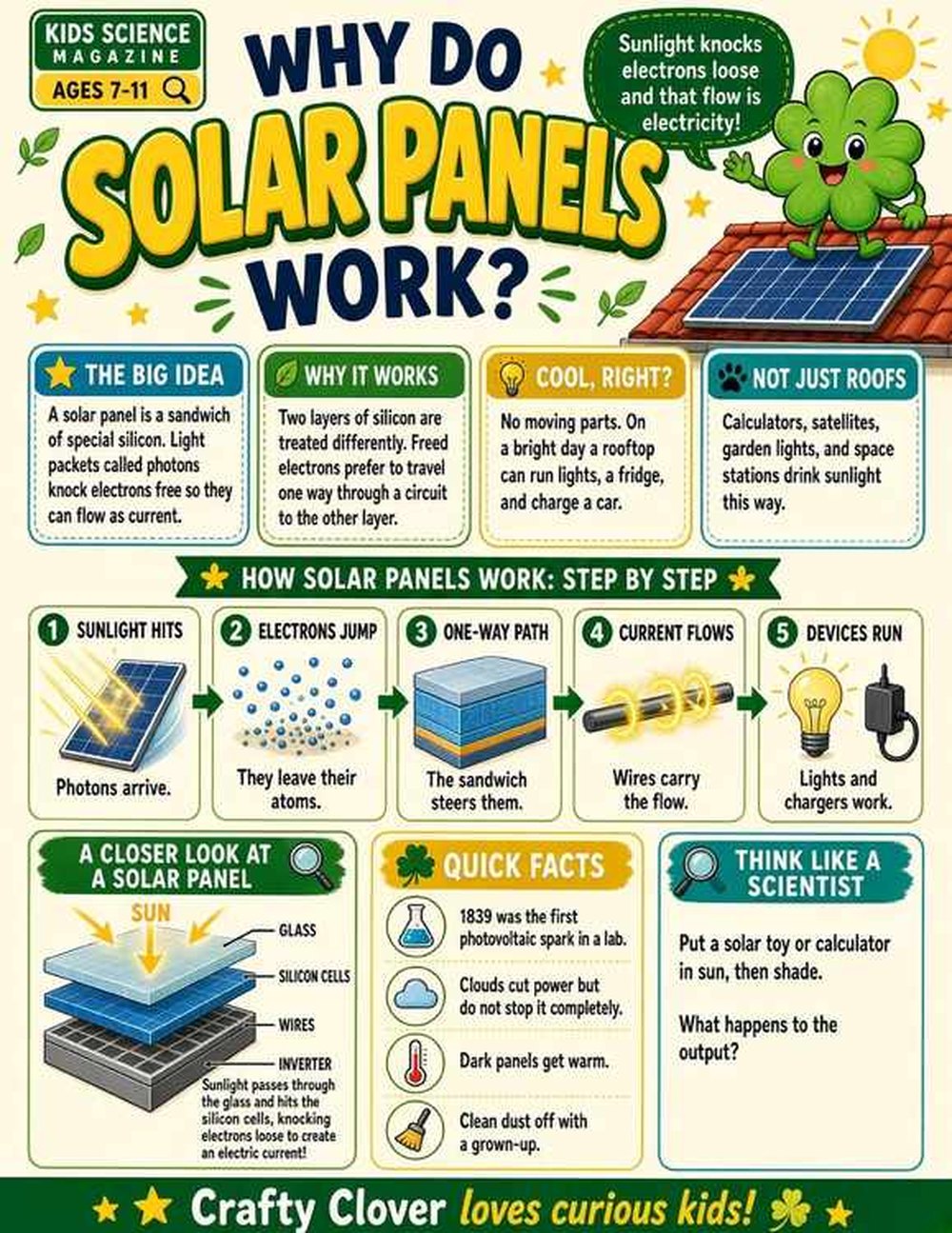
Solar panels work because sunlight hitting layers of silicon in solar cells makes electricity flow.
A solar panel is a sandwich of special silicon. Light packets called photons knock electrons free, so they can flow as current. Sunlight knocks electrons loose, and that flow is electricity!
Watch the videoWatch on YouTubeBuy on Amazon
Quick answers
What are solar cells called?
Photovoltaic or PV cells.
Sources: U.S. Department of Energy, U.S. Department of Energy, BBC
From the book
Page from A Million Whys Book 3
More fun facts
- Solar panels are made of many small solar cells, also called photovoltaic or PV cells.
- Most solar cells are made of silicon.
- When sunlight hits layers of silicon inside a solar cell, an electric charge builds up and electricity flows.
- Solar panels only make electricity in the daytime when sunlight shines on them, and they make none at night.
- Solar panels do not store energy by themselves.
- In the Northern Hemisphere, solar panels work best when they face south.
Sources: U.S. Department of Energy, U.S. Department of Energy, BBC
Questions kids ask
Do solar panels work at night?
No. They need sunlight to make electricity, so they make none in the dark.