
Book 3, Question 50
Why Does a Candle Melt?
A candle melts because the flame heats the wax, and the flame burns wax vapor drawn up by the wick.
Candle wax is a solid fuel. The flame melts the wax nearby into a liquid. The wick soaks up that liquid, and the flame burns it as vapor.
Watch the videoWatch on YouTubeBuy on Amazon
Quick answers
What is the smoke when you blow out a candle?
Wax vapor escaping.
Sources: Scientific American, Scientific American, Scientific American
From the book
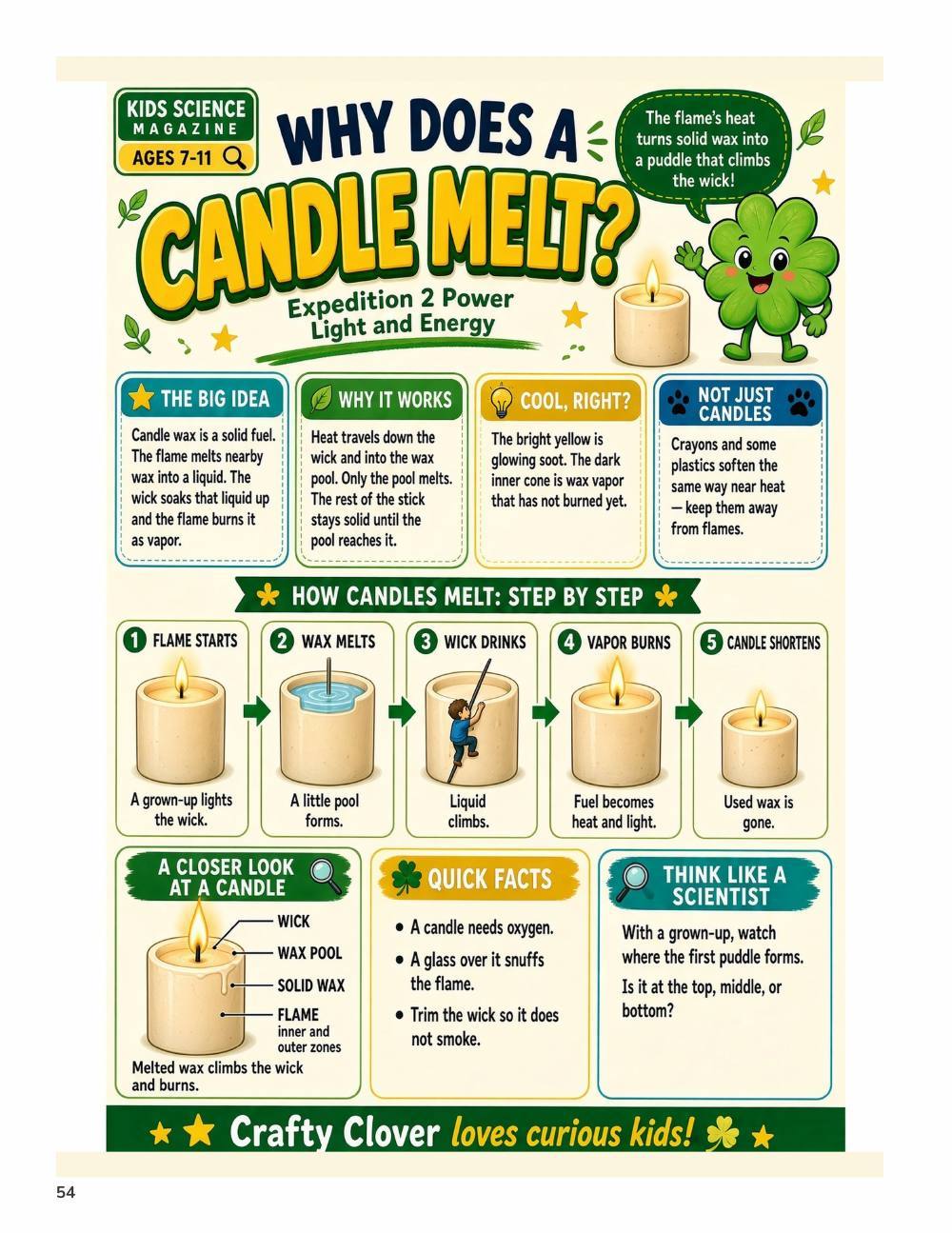
Page from A Million Whys Book 3
More fun facts
- The fuel in a candle is the wax.
- A candle flame is made by burning wax vapor, a gas, not by the wick itself or the solid wax.
- When you blow out a candle, the white smoke you see is wax vapor escaping.
- If you hold a match flame in that white smoke, the candle can light again without the match touching the wick.
- Early candles with poor wicks burned so fast that much of the wax melted and dripped away.
- The scientist Michael Faraday gave famous Christmas lectures about the science of a candle flame, which became a popular book, The Chemical History of a Candle.
Sources: Scientific American, Scientific American, Scientific American
Questions kids ask
What is the white smoke after you blow out a candle?
It is wax vapor. It can even catch fire again if you hold a flame in it.