
Book 3, Question 73
Why Do Sidewalks Crack?
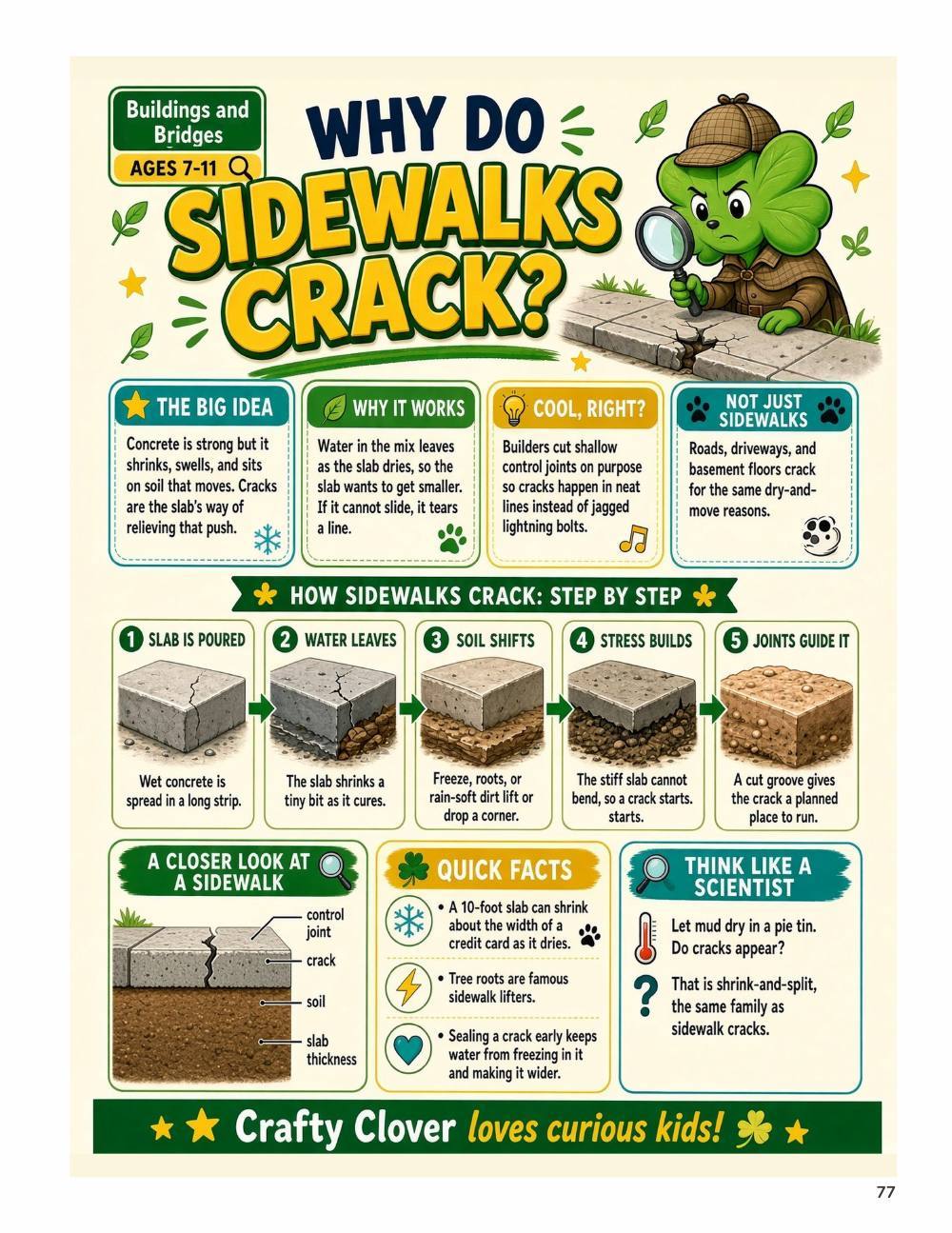
Sidewalks crack because concrete shrinks as it dries and shrinks and swells with temperature changes.
Concrete is strong, but it shrinks, swells, and sits on soil that moves. Cracks are the slab's way of relieving that push. So a crack is not always a mistake!
Watch the videoWatch on YouTubeBuy on Amazon
Quick answers
How do builders control cracks?
They cut grooves called joints so cracks form there.
Sources: fhwa.dot.gov, U.S. Forest Service
From the book
Page from A Million Whys Book 3
More fun facts
- Concrete shrinks as it dries and also shrinks and swells as the temperature changes, which builds up stress inside a slab.
- Builders cut grooves called joints to make a weak line, so cracks form along the joint instead of at random.
- Joints must be cut before the stress grows stronger than the concrete, and sooner in warm, dry or windy weather.
- As tree roots grow thicker, they can lift paths, curbs and paving slabs.
- Most of a tree's roots, often 60 to 90 percent, grow in the top 8 inches or so of soil.
- Root damage to sidewalks includes cracking, lifting and slabs that end up higher than their neighbors.
- Trouble is more likely with big or fast growing trees, trees squeezed into small spaces, and trees planted close to the sidewalk.
- Eighteen California cities together spent about 6.6 million dollars a year fixing sidewalks damaged by tree roots.
Sources: fhwa.dot.gov, U.S. Forest Service
Questions kids ask
Why do sidewalks have lines cut into them?
The lines are joints. They make weak spots on purpose, so when the concrete cracks, it cracks along the line.