
Book 3, Question 97
Why Do Robots Follow Instructions?
Robots follow instructions because their computer runs a program, a list of steps written by people.
A robot is a machine with sensors, motors, and a computer that works like a brain. It only follows its program's list of steps, unless a human changes that list. Code is like a recipe of commands, such as, roll forward until the bumper hits.
Watch the videoWatch on YouTubeBuy on Amazon
From the book
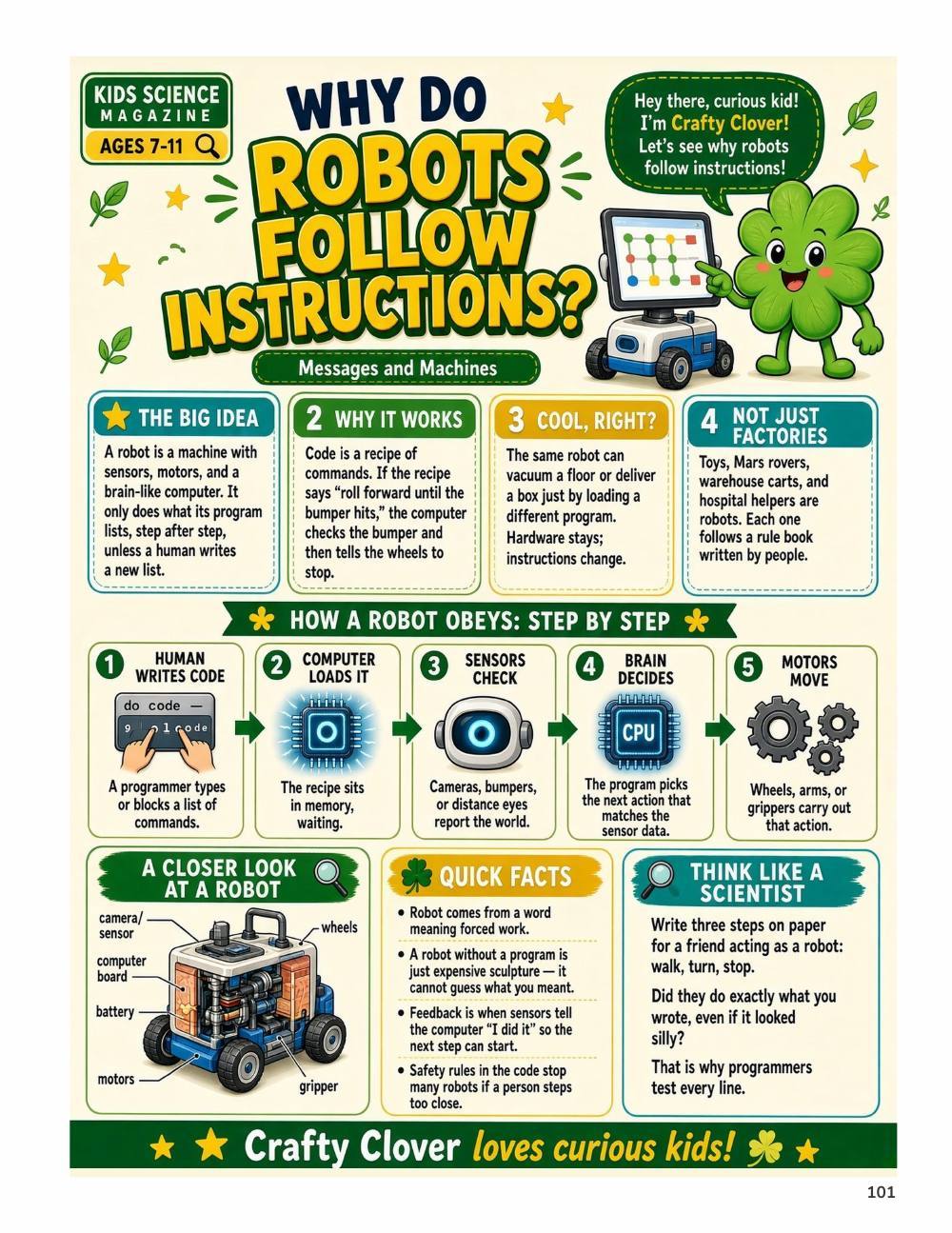
Page from A Million Whys Book 3
More fun facts
- The word robot comes from a Czech play, R.U.R. (Rossum's Universal Robots), written by Karel Čapek in 1920.
- Real robots began in the 1950s with mechanical arms built to handle dangerous radioactive materials.
- The first industrial robot went on sale in 1959.
- The Unimate was the first mass-produced robot arm for factories. Its instructions were stored on a magnetic drum.
- The first Unimate robot used on an assembly line weighed about 3,000 pounds.
- Machines followed programmed instructions long before robots. Weaving machines used punch cards as early as the 1800s.
- Car maker General Motors soon had 450 robots working in its factories.
Sources: Smithsonian Magazine, NIST, Britannica, IEEE Spectrum, The Henry Ford
Questions kids ask
How does a robot know what to do?
A robot follows instructions that people program into it. The first factory robot stored its instructions on a magnetic drum.