
Book 5, Question 33
Leaf Prints! Why Do We Find Fossils of Leaves and Wood?
We find fossils of leaves and wood because plants can leave prints in mud or turn to stone as minerals fill them.
Plants can become fossils too. A leaf can leave a print in soft mud, and buried wood can slowly turn to stone as minerals fill it. Plant fossils give clues about what ancient places looked like.
Watch the videoWatch on YouTubeSee the series on Amazon
Quick answers
What is petrified wood?
Petrified wood forms when tree trunks turn into super-hard rock but keep their growth rings.
Were horsetails always small?
Horsetail plants are small today, but long ago they grew as big as trees in swamps.
Sources: National Park Service, National Park Service, Smithsonian Magazine
From the book
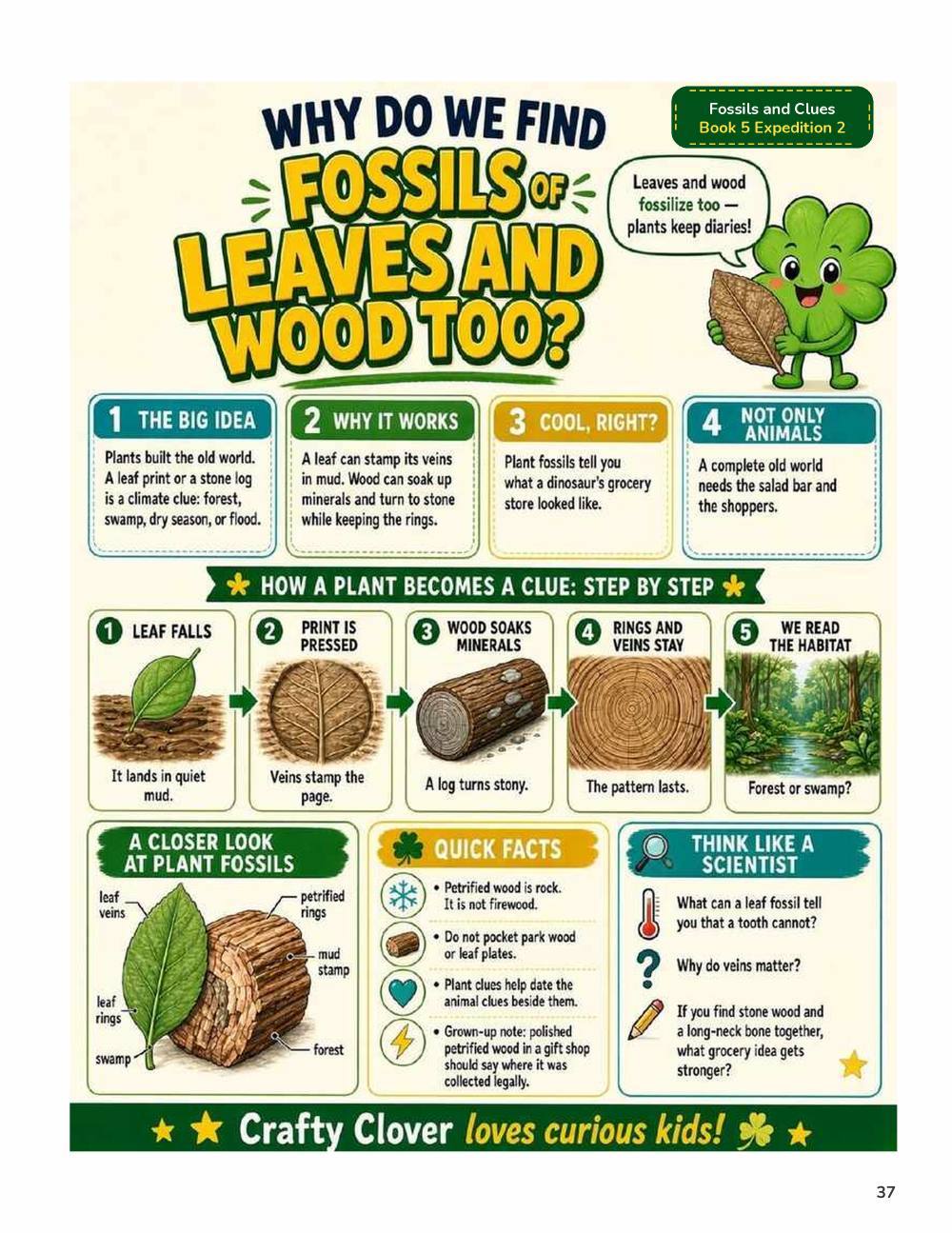
Page from A Million Whys Book 5
More fun facts
- Plants, insects, leaves, seeds and even animal poop can become fossils if conditions are right.
- Fossil plants include flowers, leaves, roots, nuts, cones, berries, needles, twigs, seeds and pollen.
- Petrified wood forms when tree trunks turn into super-hard rock but keep their growth rings and even cell shapes.
- Leaves and pollen often become fossils in a different way than bones do, more like tiny sea creatures.
- Horsetail plants are small today, but long ago they grew as big as trees in swamps.
- Some fossil leaves are so well preserved they can be peeled off the rock.
Sources: National Park Service, National Park Service, Smithsonian Magazine
Questions kids ask
Can wood turn to stone?
Yes. In petrified wood, minerals turned the wood into rock, but you can still see its growth rings.