
Book 5, Question 56
Boom or Ooze? Why Do Some Volcanoes Explode?
Some volcanoes explode because thick, sticky magma traps gas until the pressure blasts out, while runny magma just flows.
Some volcanoes have thick, sticky magma that traps gas, and pressure can build until the volcano erupts with a blast. Other volcanoes have runnier magma that lets gas escape, so lava flows out more gently. What is inside the magma changes how the eruption behaves.
Watch the videoWatch on YouTubeSee the series on Amazon
Quick answers
What makes magma sticky?
Magma rich in silica is thick and sticky and holds more gas, so it is likely to explode.
Why do Hawaii's volcanoes ooze?
Hawaii's volcanoes have low-silica magma called basalt, which flows out instead of blasting.
Sources: National Park Service, U.S. Geological Survey, National Geographic
From the book
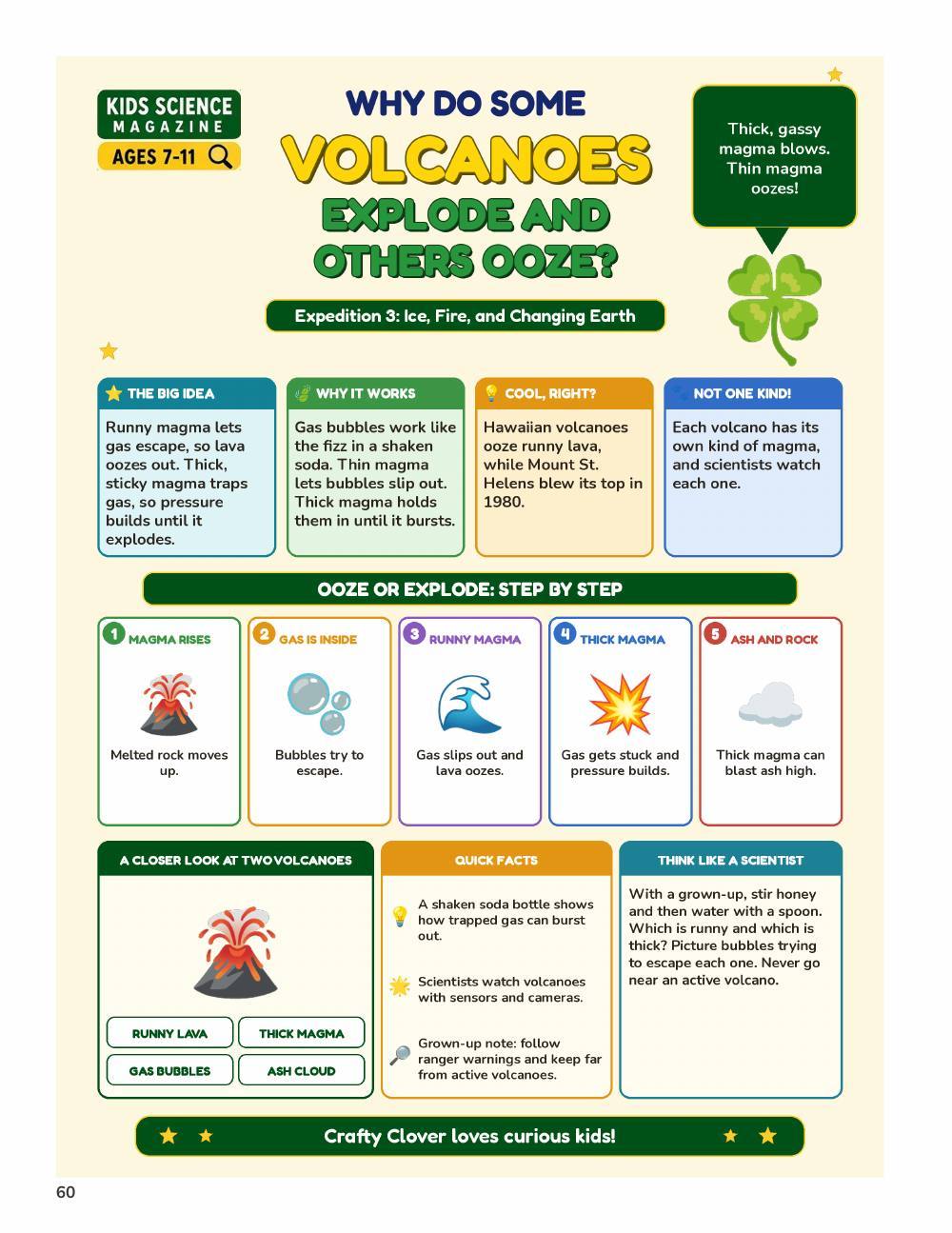
Page from A Million Whys Book 5
More fun facts
- Some eruptions are mostly gas, some are quiet flows of runny lava, and some are giant explosions.
- How explosive an eruption is depends mostly on what the magma is made of and how much gas it holds.
- Magma rich in silica is thick and sticky and holds more gas, so it is likely to explode.
- Hawaii's volcanoes have low-silica magma called basalt, which flows out instead of blasting.
- When gas cannot escape easily, pressure builds until it bursts out violently.
- An eruption can be set off when more magma pushes into the chamber underground.
Sources: National Park Service, U.S. Geological Survey, National Geographic
Questions kids ask
Why do Hawaii's volcanoes ooze instead of explode?
Their magma is runny and low in silica, so gas escapes easily instead of building up.