
Book 5, Question 71
Underground Worlds! Why Do Caves Form?
Caves form when slightly acidic rainwater slowly dissolves rock like limestone and widens tiny cracks.
Rainwater picks up a little acid from the air and soil. Where the rock is limestone, that slightly acidic water can slowly dissolve the rock and carve out empty spaces underground. Over a very long time, those spaces become caves.
Watch the videoWatch on YouTubeSee the series on Amazon
Quick answers
Where does the acid come from?
Rainwater picks up a weak acid from rotting leaves. It is the same carbonic acid that makes soda fizzy.
Sources: National Geographic, National Park Service, National Park Service
From the book
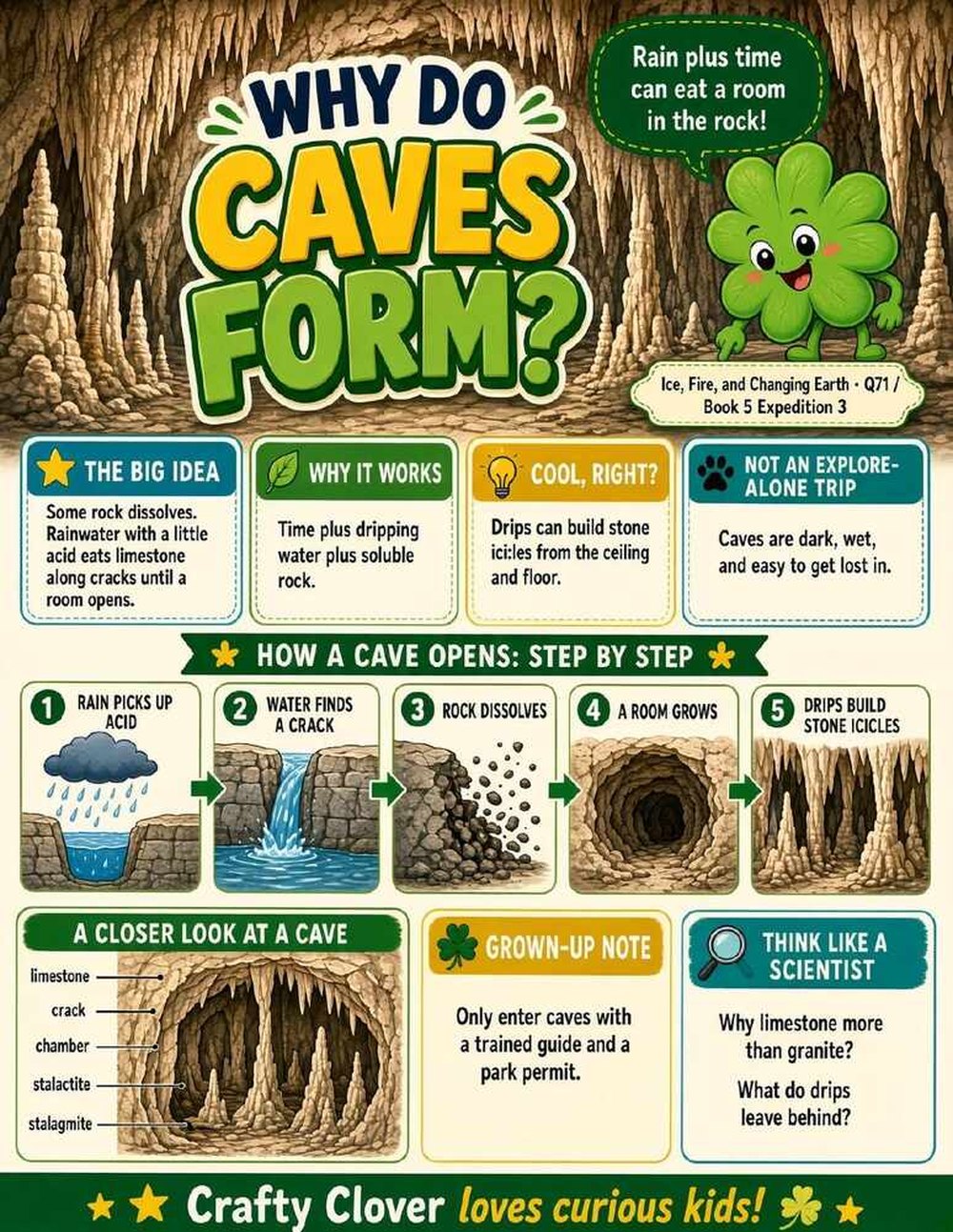
Page from A Million Whys Book 5
More fun facts
- Most caves form in rock like limestone, dolomite and gypsum that slowly dissolves in slightly acidic water.
- Rainwater picks up a weak acid from rotting leaves. It is the same carbonic acid that makes soda fizzy.
- Just as sugar dissolves in water, the mineral calcite dissolves out of the rock and is carried away.
- Over time, tiny cracks in the rock widen into caves.
- Lava tube caves form when the outside of a lava flow hardens and the hot rock inside drains away.
- Caves can even form inside glaciers, where meltwater carves tunnels through the ice.
- When a stalactite and a stalagmite meet, they form a column.
Sources: National Geographic, National Park Service, National Park Service
Questions kids ask
Why do many caves have springs?
Caves are carved by water, and water often still flows through them and out into springs.