
Book 5, Question 104
Half a Skeleton? Why Is a Fossil Not Always Whole?
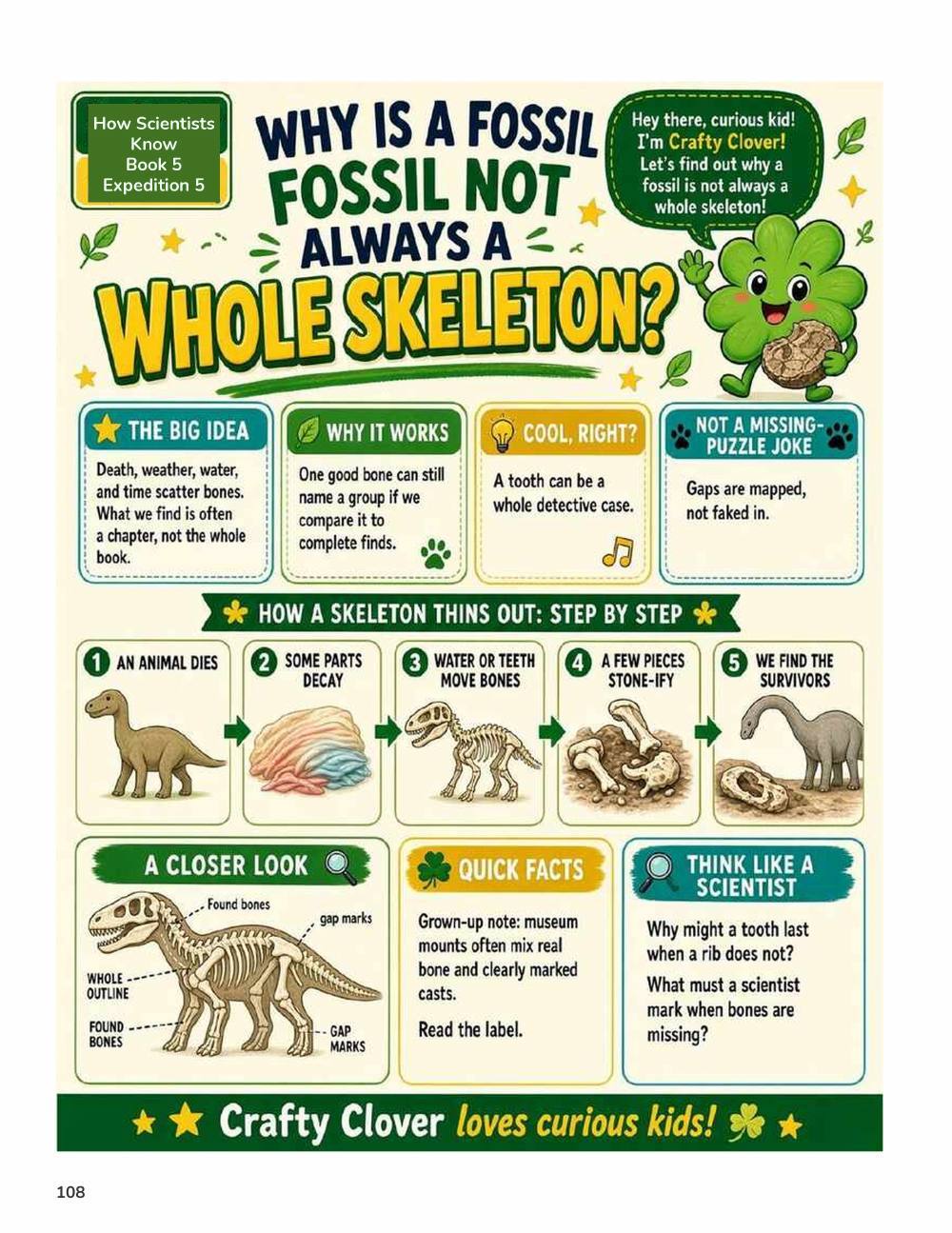
A fossil is not always whole because scavengers, erosion and the rare conditions needed for fossils mean most parts never survive.
Fossils often have missing pieces because most of an animal's body does not survive to become a fossil. Scientists use the parts they have and compare them with related animals. They are careful to explain what is known and what is a good guess.
Watch the videoWatch on YouTubeSee the series on Amazon
Quick answers
How complete is SUE the T. rex?
SUE has 250 of the roughly 380 bones in a T. rex skeleton.
Source: fieldmuseum.org
From the book
Page from A Million Whys Book 5
More fun facts
- Fossils are rare, because the conditions have to be just right for them to form.
- After an animal dies, scavengers can drag bones away, and erosion can wear away fossils before anyone finds them.
- SUE, the most complete adult T. rex found so far, has 250 of the roughly 380 bones in a T. rex skeleton.
- By bone volume SUE is about 90 percent complete, because many of the missing bones are small ones.
- The giant titanosaur Máximo was described from about 130 fossil bones from more than six different animals.
- No one has found a single complete skeleton of that titanosaur yet.
- Rock that hardens around bones often squishes and bends them out of shape.
Sources: fieldmuseum.org
Questions kids ask
How complete is SUE the T. rex?
SUE has 250 of about 380 bones, and is about 90 percent complete by bone volume.